

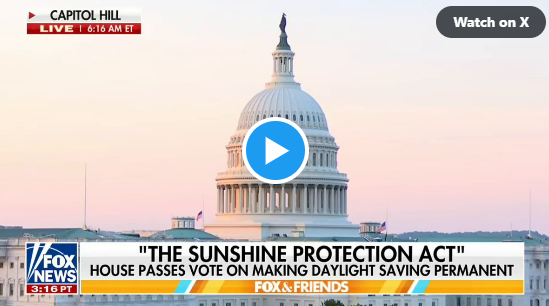


IT’S OFFICIAL: Legislation has PASSED the House to abolish changing clocks twice per year, making Daylight Saving Time permanent PRESIDENT TRUMP: “We are…SAVING DAYLIGHT, which gives you a longer, brighter day!” Now the Senate must approve it before it goes to POTUS for signature
🚨 IT’S OFFICIAL: Legislation has PASSED the House to abolish changing clocks twice per year, making Daylight Saving Time permanent
PRESIDENT TRUMP: “We are…SAVING DAYLIGHT, which gives you a longer, brighter day!”
Now the Senate must approve it before it goes to POTUS for… pic.twitter.com/iEcUHzTva7
— Eric Daugherty (@EricLDaugh) July 15, 2026
On July 14, 2026, the U.S. House of Representatives voted 308-117 to pass a bill that would end the twice-yearly clock changes most Americans know well. The Sunshine Protection Act of 2025 would make daylight saving time (DST) last all year long in most of the country. If the Senate also passes it and President Donald Trump signs it into law, people would no longer have to “spring forward” in March or “fall back” in November.
The bill, introduced by Congressman Vern Buchanan (R-Florida), has strong bipartisan support and backing from President Trump. Trump has called the twice-yearly clock changes a “ridiculous, twice-yearly production.” A similar bill passed the Senate in 2022 but never became law because the House did not act on it at the time.
What Is Daylight Saving Time?
Daylight saving time is the practice of moving clocks ahead one hour in the spring and back one hour in the fall. It was originally created during World War I to save energy by giving people more daylight in the evenings during summer months. Today, most of the United States observes DST from March to November. A few states and territories already stay on standard time year-round.
Under the new bill, the later “summer” time would become the permanent time for most states. That means more evening daylight for after-school sports, family time, outdoor activities, and businesses. However, in winter it would also mean later sunrises—sometimes as late as 8 or 9 a.m. in northern states.
Why Supporters Want the Change
Lawmakers say Americans are tired of changing their clocks twice a year. The switch can disrupt sleep, school schedules, and work routines. Supporters argue that keeping one consistent time all year would bring real benefits:
- Better and more consistent sleep schedules
- Fewer car accidents because of steadier routines
- More usable evening daylight for exercise, shopping, and family activities
- A boost to the economy from extra evening hours for businesses
- Energy savings in some cases
How do you feel about the sun not rising until after 8 AM in December if the Sunlight Protection Act passes? pic.twitter.com/CqOcV0P77O
— Vince Langman (@LangmanVince) July 15, 2026
During debate, Rep. Brett Guthrie (R-Kentucky), chairman of the House Energy and Commerce Committee, said: “Americans are overwhelmingly supportive of this policy. Locking the clock all year long would have positive impacts on sleep schedules, energy conservation, motor vehicle safety and our economy.”
Rep. Gus Bilirakis (R-Florida) added that Floridians have long been “tired of the outdated and unnecessary practice of changing the clocks twice a year.” He noted it disrupts daily routines for families and businesses.
Rep. Vern Buchanan, the bill’s main sponsor, said the legislation “reflects what Americans have been saying for years: it’s time to lock the clock and make daylight saving time permanent.” He highlighted improvements in public safety and healthier, more active lifestyles.
President Trump posted support for “SAVING DAYLIGHT, which gives you a longer, brighter day!”

What Happens Next?
The bill now moves to the Senate. If senators approve it, it goes to President Trump for his signature. States that currently have exemptions from DST could choose to stay on standard time year-round instead.
Some People Have Concerns
Not everyone supports permanent daylight saving time. Critics worry that darker winter mornings could make it harder for students to get to school and for people to commute safely to work. In northern parts of the country, sunrise could be pushed back by a full hour. A brief experiment with year-round DST in the 1970s was quickly reversed because many people disliked the dark mornings.
Some health experts also point out that our bodies follow natural sunrise and sunset patterns. A sudden permanent shift could affect sleep and mood for some people, at least at first. A few lawmakers prefer making standard time (the earlier time) permanent instead.
Should daylight savings be permanent? pic.twitter.com/X2Z24VSXzz
— Barstool Sports (@barstoolsports) July 15, 2026
A Long-Standing Debate
This is not the first time Congress has tried to end the clock changes. The 2022 Senate version passed easily but stalled in the House. Many states have already passed their own laws or resolutions asking for permanent DST if Congress allows it. Florida was one of the first to push for it years ago.
Polls have shown that a strong majority of Americans want to stop changing the clocks twice a year, even if opinions differ on whether the permanent time should be the later DST version or the earlier standard time.
Bottom Line
The House vote on July 14, 2026, marks the biggest step in years toward ending the twice-yearly clock ritual. The Sunshine Protection Act now heads to the Senate. If it passes there and gets signed into law, most Americans would finally have one steady time all year long—bringing longer, brighter evenings but also darker winter mornings in some places.
Whether you love the idea of more evening daylight or prefer keeping mornings lighter in winter, this bill is a major move in a debate that has lasted for decades.
- The Whatfinger News Team: Ben, Beth, Luke, Alex…
References
- House Passes Legislation to Make Daylight Saving Time Permanent — U.S. House Committee on Energy and Commerce (official statements from Reps. Guthrie, Bilirakis, and Buchanan)
- House passes Trump-backed bill that would make daylight saving time permanent — NBC News
- House passes bill to ‘ditch the switch’ and make daylight saving time permanent — Associated Press
- H.R.139 – Sunshine Protection Act of 2025 — Congress.gov (official bill text and status)
- Sunshine Protection Act — Wikipedia (historical background on previous attempts, including the 2022 Senate passage and 1970s experiment)
- Original post by @EricLDaugh on X (July 15, 2026) with President Trump’s reaction and vote details
Just In: President Trump Orders Fresh Strikes on Iran to Shield Shipping and Force a Deal. Now we bomb them during the day as well, as their air defenses are now non-existent thanks to our bombing campaign – Whatfinger’s D.I.
Get on over to Whatfinger.com – Whatfinger News does millions of pageviews a month for a reason…. Truth, Justice, the American way, plus news on the Left as well – all links from all sites gives you the true news. – CLICK HERE 🛑

