




Explore the incredible story of ancient secret passages that were sealed for thousands of years. Hidden beneath temples, pyramids, castles, and forgotten ruins, these mysterious passageways have amazed archaeologists and historians alike. Discover the latest archaeological discoveries, ancient mysteries, lost civilizations, and the fascinating secrets concealed behind sealed entrances that remained untouched for millennia.
More Info – we at Whatfinger News love to give you the facts, the mystery and the theories… You decide what you think is the truth.
Graham Hancock just dropped a devastating blow to mainstream archaeology with the Great Pyramid of Giza.
“It’s a 6 million ton monument… more than 2 million individual blocks of stone.”
“The Great Pyramid is aligned within 3/60ths of a single degree to true north… on a 6… pic.twitter.com/dsJkYMatyz
— Defiant Ghost (@TheDefiantGhost) June 15, 2026
The Great Pyramid of Giza (Pyramid of Khufu) is one of humanity’s greatest engineering achievements, and it continues to spark genuine wonder. The article you linked on Whatfinger Community seems to highlight recent non-invasive discoveries of hidden voids and corridors—exciting real finds from projects like ScanPyramids that use muon tomography, radar, ultrasound, and endoscopy. These include the “Big Void” (detected 2017, above the Grand Gallery) and the North Face Corridor (confirmed 2023, a ~9m passage behind the original entrance area). Similar recent work (2025–2026) has identified small air-filled voids in the nearby Pyramid of Menkaure.
These are real “sealed for thousands of years” features revealed by modern physics, not ancient super-tech or lost civilizations. They’re most likely construction-related voids or unfinished elements rather than treasure chambers or power plants.
Here’s a clear breakdown addressing your specific questions, grounded in evidence from Egyptology, radiocarbon dating, inscriptions, logistics records (like the Diary of Merer papyri), and engineering analysis.
Thank you to @joerogan for having me on the JRE podcast.
Would you like to explore the subterranean shaft beneath the Great Pyramid? The subterranean shaft in the Great Pyramid of Giza (also known as the “well shaft” or “service shaft”) is a complex, 200-foot (60 m) passage… pic.twitter.com/UmVAA6zpBz— Billy Carson II (@4biddnKnowledge) June 28, 2026
Was it built long before the Egyptians?
No credible evidence supports this. The mainstream consensus—backed by multiple independent lines of evidence—places construction firmly in the Fourth Dynasty of the Old Kingdom, around 2580–2560 BCE, during Pharaoh Khufu’s reign (about 4,500–4,600 years ago).
Key evidence includes:
- Radiocarbon dating of charcoal, mortar, and organic material embedded in the pyramid and associated structures consistently points to ~2500 BCE.
- Quarry marks and graffiti in the relieving chambers above the King’s Chamber that explicitly name Khufu and his work gangs (discovered in the 1830s and corroborated multiple times).
- Contextual archaeology: The pyramid fits perfectly in the evolutionary sequence of Egyptian pyramid-building (Djoser’s step pyramid → Sneferu’s bent and red pyramids → Khufu’s true pyramid). Worker villages, tools, bakeries, and cemeteries at Giza match this period.
- Logistics records: The Diary of Merer (ancient papyri) details teams transporting limestone from Tura quarries to Giza specifically for Khufu’s pyramid.
Claims of a much older date (e.g., 10,000–23,000+ BCE based on erosion/weathering patterns in a recent non-peer-reviewed engineering study) exist in alternative circles but are rejected by archaeologists. Erosion rates are highly variable and unreliable (affected by sand cover, wind, modern pollution, and uneven exposure), and such an early advanced civilization would have left abundant traces—pottery, tools, settlements, bones—that are completely absent at Giza and across Egypt.
The pyramid was built by ancient Egyptians using the knowledge, labor organization, and simple machines available in the Old Kingdom. It represents the peak of a long development in Egyptian monumental architecture, not a sudden arrival from a lost earlier civilization.
Thanks to Harvard University, you can now virtually enter the Great Pyramid of Giza in 3D and 360º pic.twitter.com/7ZYVanpZuu
— Tansu Yegen (@TansuYegen) November 11, 2022
The technology used — Could we build it even today with current tech?
The technology was impressive but not supernatural. Ancient Egyptians used:
- Local limestone (most blocks ~2.5 tons average; some much larger) quarried with copper chisels, dolerite pounders, and wooden wedges swollen with water.
- Granite from Aswan (~800 km south) for the King’s Chamber and beams (some 50–80 tons).
- Transport via Nile boats and sledges on lubricated paths (water or possibly other lubricants reduced friction dramatically—modern experiments confirm this works well).
- Lifting/placement via ramps (external straight or zig-zag, and likely internal spiral ramps per Jean-Pierre Houdin’s well-supported theory), levers, counterweights, and rocking techniques. The workforce was large (estimates 20,000–40,000+ skilled workers and support staff over ~20–30 years), well-fed, and organized in rotating teams—not primarily slaves.
Yes, we could absolutely build it (or better) today. This claim is a common myth in alternative media. Modern engineers and construction experts agree it would be far easier and faster with current technology:
- Tower cranes, heavy-lift helicopters, and trucks could move and place the blocks with precision.
- GPS, lasers, and computer surveying would make the near-perfect cardinal alignment (within a few arcminutes) trivial.
- A concrete version (as many modern analyses suggest for a replica) would be dramatically simpler and cheaper—estimates for a full modern replica range from hundreds of millions to ~$5 billion depending on exact stone-vs-concrete methods and labor assumptions.
The real ancient achievement was logistics, organization, and sustained effort over decades with Bronze Age tools. We replicate far more complex projects routinely (skyscrapers, dams, tunnels). An exact hand-tool stone replica would still be expensive and time-consuming due to labor costs, but it is entirely within our capabilities.
Other enduring mysteries and questions
Here are some of the most discussed ones, with current understanding:
- Purpose of the internal voids and chambers — The King’s Chamber, Queen’s Chamber, Grand Gallery, air shafts, and now the Big Void and North Face Corridor continue to intrigue. Most Egyptologists see them as structural (weight distribution via relieving chambers) or construction-related. The Big Void and North Face Corridor were likely left during building or served specific engineering purposes. No evidence supports “power plant,” resonance machine, or alien tech theories.
- How the heaviest stones (especially granite) reached the upper levels — Still debated in detail. Internal ramp theories, lever systems, and temporary wooden structures are leading explanations. Experiments show multi-ton blocks can be moved and lifted with period-appropriate methods.
- Astronomical and mathematical precision — The base is remarkably square and level, and sides align closely to true north. This was achieved with stellar observations (circumpolar stars), sighting rods, and geometry—impressive but within reach of skilled Old Kingdom surveyors. Claims of encoded pi, Earth’s circumference, or perfect golden ratio are often overstated or cherry-picked; many are coincidental or result from measurement choices.
- Why so few inscriptions inside the main structure? — Unlike later pyramids or temples, the main chambers are stark. However, the relieving chambers do have Khufu’s name and gang graffiti. The pyramid was likely robbed in antiquity (like most royal tombs), which is why no mummy or major treasures were found by modern explorers.
- Exact construction timeline and workforce — We have good estimates but not day-by-day records. It was a national project involving skilled craftsmen, not just brute force.
The pyramid’s enduring appeal comes from its sheer scale combined with the mystery of “how exactly?”—but ongoing scientific work (muon scanning, 3D modeling, experimental archaeology) keeps narrowing the unknowns without needing lost advanced civilizations.
More….
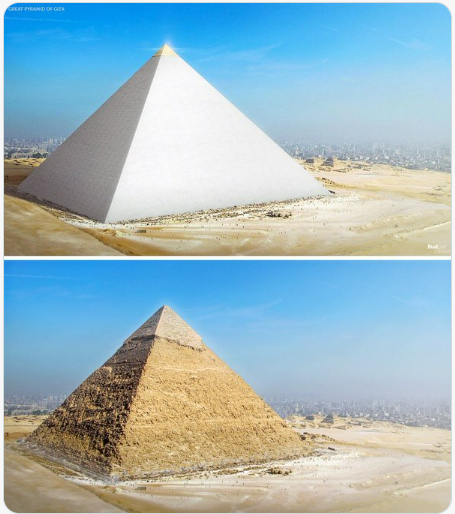
This is your reminder that Cleopatra lived closer in time to today than she did to the construction of the Pyramids of Giza. They are impossibly old. More mind-blowing facts about the world’s most enigmatic structures: 1. They are aligned to true north with incredible accuracy. The Great Pyramid is just 3.4 arcminutes off perfect alignment, or precision of ~1 millimeter per meter of the length of its base. 2. The Great Pyramid was the tallest building in the world for around 3,800 years, until it was surpassed by Lincoln Cathedral in the 14th century. 3. They do not contain any hieroglyphs or paintings, nor were any burial treasures or mummies found within. By contrast, the tombs at the Valley of the Kings are decorated with intricate hieroglyphic texts and artworks from floor to ceiling. 4. They were once covered in gleaming white limestone casing stones (as pictured). Some researchers also think the capstones at the top were plated with precious metals. 5. ~2.3 million stone blocks make up the Great Pyramid, averaging 2.5 tons in weight. Quarrying these with little else than copper saws, chisels and pounding stones, then transporting and lifting them into place, is the most remarkable engineering feat ever accomplished. 6. The casing stones and inner chamber blocks of the Great Pyramid were fit together with such high precision that a knife’s edge cannot fit between them. 7. The Great Pyramid weighs nearly 6 million tons in total. Today, the only structures exceeding this are the Great Wall of China and the Three Gorges Dam. 8. When Napoleon visited the Great Pyramid in the late 18th century, he (correctly) calculated that it contained enough material for a 10-foot high wall around the entire perimeter of mainland France. 9. Of the thousands of hieroglyphs found across Egypt, none of them mention how the pyramids were built or how the Egyptians cut stone. In fact, there are very few Ancient Egyptian texts found which mention the pyramids at all.
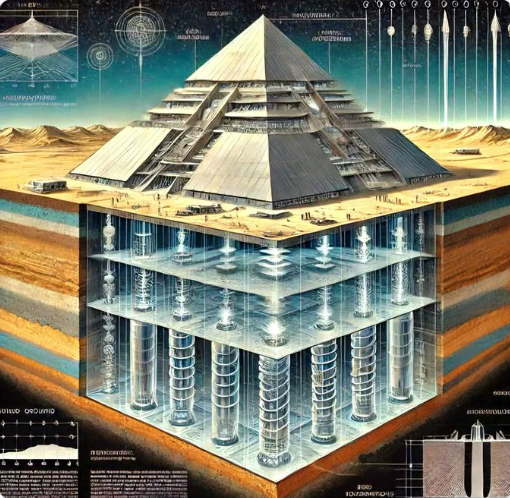
Billy Carson: SAR Scan of Khafre Pyramid Shows Huge Underground Structures. Deep beneath the Great Pyramid of Giza, hidden from the eyes of the world, archaeologists have made a discovery that could change everything we think we know about our history. Eight gigantic, spiral-shaped cylindrical structures descend more than 600 meters into the depths reaching toward the Earth’s core, into a concealed dimension of knowledge. If this discovery proves to be true, it would not only be the most significant archaeological revelation of our time but also evidence that our past is far more complex than we have been led to believe. Perhaps it is the confirmation of what many have long suspected: that there is a hidden history one that has been deliberately kept from us. What secrets might lie within these deep chambers? Who built them, and for what purpose? The answers could forever change our understanding of humanity. Let’s explore this together on the 4bidden Tour Of Egypt 2025. LINK IN BIO (Post at X)
Get on over to Whatfinger.com – Whatfinger News does millions of pageviews a month for a reason…. Truth, Justice, the American way, plus news on the Left as well – all links from all sites gives you the true news. – CLICK HERE 🛑

Books Reviewed by the Whatfinger News Crew
- The Return of the King: Epic Battles, Bittersweet Victory, and Why It Still Hits So Hard
- A Game of Thrones: Backstabbing, Betrayal, and Why We Can’t Stop Reading – Full Whatfinger Chapter
- The Wrath and the Dawn: Vengeance, Forbidden Love, and Arabian Nights Magic – Full Whatfinger Chapter
- Why The Hobbit Still Feels Like Pure Magic: Bilbo, Dragons, and the Comfort of Home
- Outlander: Time Travel, Hot Highlanders, and a Romance That Refuses to Be Tamed
- Why A Wizard of Earthsea Still Hits Different: True Names, Hubris, and the Shadow We All Carry
- The Fifth Season: A Brutal, Brilliant Apocalypse That Refuses to Comfort You

As an Amazon Associate, I earn from qualifying purchases.
